Showing posts with label Artists I Admire. Show all posts

Monday, November 23, 2015

Training and Use of Visual Memory, Deborah Paris TRAC 2015

Morning Light Deborah Paris
24 x 30 inches
As mentioned, I learned much from Deborah Paris's presentation at TRAC earlier this month:
In her presentation, Paris reminded us of how memory works and how memory training was once considered a significant part of training for artists. Her presentation reinforced the importance of memory in loosening the contemporary reliance on photography as a reference tool and showed how memory provides a bridge to working from imagination.

The memory training method described by Paris is a logical extension of training made known by Horace Lecoq de Boisbaudran along with new, contemporary techniques developed by Paris.

In a nutshell (and as I remember it), the basic steps in this training, when working from a master drawing for example, are as follows:

   The big stare - at least 10 minutes of focused observation

   Describe what is observed to another person (or yourself) and/or write about the observation

   Make an air drawing - trace the contours of the subject in the air with your pencil, brush, or finger. 

   Make a drawing based on the memory and compare it to the original. 

   Repeat the process to strengthen and develop observation and memory skills.

It may seem odd that writing about an observation or verbally describing it to someone would help, until you remember that memory works by association. The stronger the associations the more quickly and fully a memory can be retrieved. Associations can be formed from a variety of sensory and cerebral input. In training for a massage therapy license, a group of us had heard that scent aids recall. We agreed together to use peppermint, and so studied and memorized with peppermint oil and we all wore peppermint oil to our final exam.


George Innes
Other training methods include removing oneself further and further from the subject, in both time and space. A friend who long ago attended the School of Visual Arts recalls drawing classes where the model would be on one floor and the easels on another. One either sharpened memory skills or got more of a workout than bargained for.


Nocturne James Abbott McNeill Whistler
You can see how useful this training can be when you want to work from imagination, or consider the many subjects that do not easily lend themselves to a photographic reference, such as the magical hours of dawn and dusk or the constantly changing clouds and ocean, or the night sky, or stars, comets, lightning, and volcanoes.

I've just touched the surface of Deborah Paris's presentation, and the subject of memory training in general. Fortunately, I understand that her paper will be published at some point.

UPDATE: Deborah Paris's paper is now online. Here's the link: http://www.deborahparis.com/Asset.asp?AssetID=42291&AKey=LCEK6WCL

Keep your eye on Field Notes  - Paris's teaching blog.

A few more resources:

Horace Lecoq de Boisbaudran's book is available online here:
The Training of the Memory in Art and the Education of the Artist

Memory Drawing 2 Stapleton Kearns


Memory Drawing Techniques  Carol Allison

Deborah Paris's offering of online classes and field and studio workshops can be found here:
Deborah Paris, The Landscape Atelier classes and workshops.

Monday, November 09, 2015

15 of the Best Quotes About Art

Study of a Tree Vincent van Gogh
"I am always doing what I can't do yet in order to learn how to do it." Vincent van Gogh, to Anthon Rappard, August 1885

"The things that go into making a painting—the scale of the canvas, the shape of the rectangle, the texture of the surface, the length and force of the brushstroke, the selection of colors—all those things are connected to the painter at the deepest level, the way he or she orders the world. " - Eric Fischl and Michael Stone, Bad Boy: My Life On and Off the Canvas 

"Some painters transform the sun into a yellow spot, others transform a yellow spot into the sun." - Pablo Picasso


Horse Bath Odd Nerdrum
"Light is good for the body, darkness is good for thought. Dusk is where they meet."  - Odd Nerdrum

“Don't worry about your originality. You couldn't get rid of it even if you wanted to. It will stick with you and show up for better or worse in spite of all you or anyone else can do.” - Robert Henri
  
"What is essential in a work of art is that it should rise far above the realm of personal life and speak to the spirit and heart of the poet as man to the spirit and heart of mankind." - Carl Jung

Seashore in Moonlight Caspar David Friedrich
"The artist's feeling is his law" - Caspar David Friedrich

"The reason people are so moved by art and why artists tend to take it all so seriously is that if they are real and true they come to the painting with everything they know and feel and love, and all the things they don’t know, and some of the things they hope, and they are honest about them all and put them on the canvas. What can be more serious? What more really can be at stake except life itself, which is why maybe artists are always equating the two and driving everybody crazy by insisting that art is life. Well. Cut us some slack. It’s harder work than one might imagine, and riskier, and takes a very special and dear kind of mad person. " - Peter Heller, The Painter: A novel


Red Rust Hills Georgia O'Keeffe
"Making your unknowns know is the important thing." - Georgia O'Keeffe

Spring Andrew Wyeth
"I dream a lot. I do more painting when I'm not painting. It's in the subconscious." - Andrew Wyeth


The Goldfinch Carel Fabritius
“An individual heart-shock. Your dream, Welty’s dream, Vermeer’s dream. You see one painting, I see another, the art book puts it at another remove still, the lady buying the greeting card at the museum gift shop sees something else entire, and that’s not even to mention the people separated from us by time—four hundred years before us, four hundred years after we’re gone—it’ll never strike anybody the same way and the great majority of people it’ll never strike in any deep way at all but—a really great painting is fluid enough to work its way into the mind and heart through all kinds of different angles, in ways that are unique and very particular. Yours, yours. I was painted for you." - Donna Tartt, The Goldfinch  

"Any great work of art revives and re-adapts time and space, and the measure of its success is the extent to which it makes you an inhabitant of that world." - Leonard Bernstein 


Self Portrait as a Young Man Rembrandt
"Without atmosphere a painting is nothing." - Rembrandt Harmenszoon Van Rijn

"That is what perfect painting is: neither entirely dull water and stone, nor weightless representation. Not merely a wooden panel coated with cracked and abraded paint, nor entirely a madonna and child. Or as in Rembrandt, not just a slather of oil, nor simply a face. Perfect painting is imperfectly transcendent. Less interesting painters do not know what to do with the choice between substance and illusion. Poor painting does not push the equivocation as far as it can go, until the paint teeters on the edge of transcendence. An unsuccessful picture might have a passage where the paint doesn't matter at all, and the forms might just as well have been photographed instead of rendered in oil. Then in another place the paint might suddenly become obtrusive, and distract the viewer from the contemplation of some distant landscape, bringing the eye sharply back to the surface of the canvas. It may be that the human mind can only think of one aspect at a time: either a painting is what it represents, or it is a fabrication done on a flat surface. Or perhaps it is possible to think of both the surface and what seems to be behind it at once, in a "twofoldness" of attention that takes in both equally." - James Elkins, What Painting Is


"Art is a lie that tells the truth." - Pablo Picasso

These are some of my current favorites, the ones that are motivating, making me think, and look. A few of these quotes come from novels; fiction about art or that includes an art theme in the storyline. I think novels, like painting, can be "a lie that tells the truth". What would you add to this list?

Monday, October 19, 2015

Storm, Eucalyptus Tree Sketch

Storm, Eucalyptus Tree ©2015 Katherine Kean
graphite 10 x 12 inches

I'd like to make this a larger painting. I've been working on small and medium size work the past three months. I work in the smaller space under my house in the summer. It's much cooler! Now that the days are getting shorter and aren't as hot, I've moved back into the larger space, allowing me to scale up. 

 I was pretty happy with this sketch until I decided that the tree is just too static. Considering the wind that's pushing all the clouds around it ought to be moving, or bending. I'm looking at these Burchfield and Hopper paintings for inspiration. I'd be happier if I can get the tree to have the same feeling of wind and energy that I get from these paintings.


 March Winds  Charles Burchfield


Windy Day Edward Hopper

And then, just about the time I was wondering where to turn for inspiration, I got lucky.


The Santa Anas came. Above, a quick video of a neighbor's enormous Eucalyptus in the wind.

And last, a revised windy tree.

Monday, October 12, 2015

A Cool Idea - Lawren Harris, The Idea of North

Mount Lefroy Lawren Harris
I like being reminded of North. Never more so than at the tail end of a late season heat wave while living in a hot, dry, congested city like Los Angeles. Lawren Harris's paintings do a remarkable job of transcending summer at the newly opened exhibition at the Hammer Museum titled, The Idea of North.

Mountains Near Jasper Lawren Harris 
To many of us here in the Northern Hemisphere, the idea of north means cool, cold, snow. It may also mean remote, and isolated.

Isolation Peak Lawren Harris
The blues are strong, the shadows deep. The whites are made of many pale shades of yellow, gray, violet, and even green.


Included among the large paintings were smaller versions; studies and variations. Many of them painted on beaver board; once a trademark, beaver board is a compressed fiberboard.

In Buchanan Bay, Ellsmere Island Lawren Harris
Arctic Sketch XXII Lawren Harris

Harris's paintings admirably restrained, simplify form. These landscapes are refined to essential shapes and subtle palette choices, giving us the peace and space we crave.

This refinement has not reduced the sense of scale and strength. Harris has not left out the sense of awe and sweeping grandeur and immensity these landscapes evoke.

Lawren Harris

Monday, May 11, 2015

Painting Dusk

Caspar David Friedrich A Walk at Dusk
Have you noticed how sometimes the sky at dusk creates an unbearable phenomena of color? I am often startled when I see it and pause to look and try to imagine what color, or combination of colors, might create the same indescribable low light effect in paint. I'm thinking of that almost colorless color that is still somehow full of light. The Friedrich painting above comes close in some ways to what I am thinking of.

Edward Hopper Shakespeare at Dusk
Conversely, sometimes at dusk one color seems to predominate. I suspect that part of the secret is in how our eyes perceive at this time of day. Hopper above, and Shaw below, nail down the effect simply and boldly.

George Shaw Scenes From the Passion: 10 Shilling Wood
Romantic pastoral or urban decadent, the indeterminate light of dusk compels with it's elusiveness, it's mystery, and it's mood - whatever that might be.

John Felsing Far From Babylon
Other well known favorites are George Innes, Atkinson Grimshaw, Dwight Tryon, the tonalists.

Suburban Murmuration 2 work in progress
©2015 Katherine Kean
This last one is a work in progress, with much to be done to the house.

For more on this topic from others follow these links:

Nocturne: prettiness in a face-off with edgelands grit

The Phenomenology of Twilight

Monday, January 12, 2015

Animals On My Mind


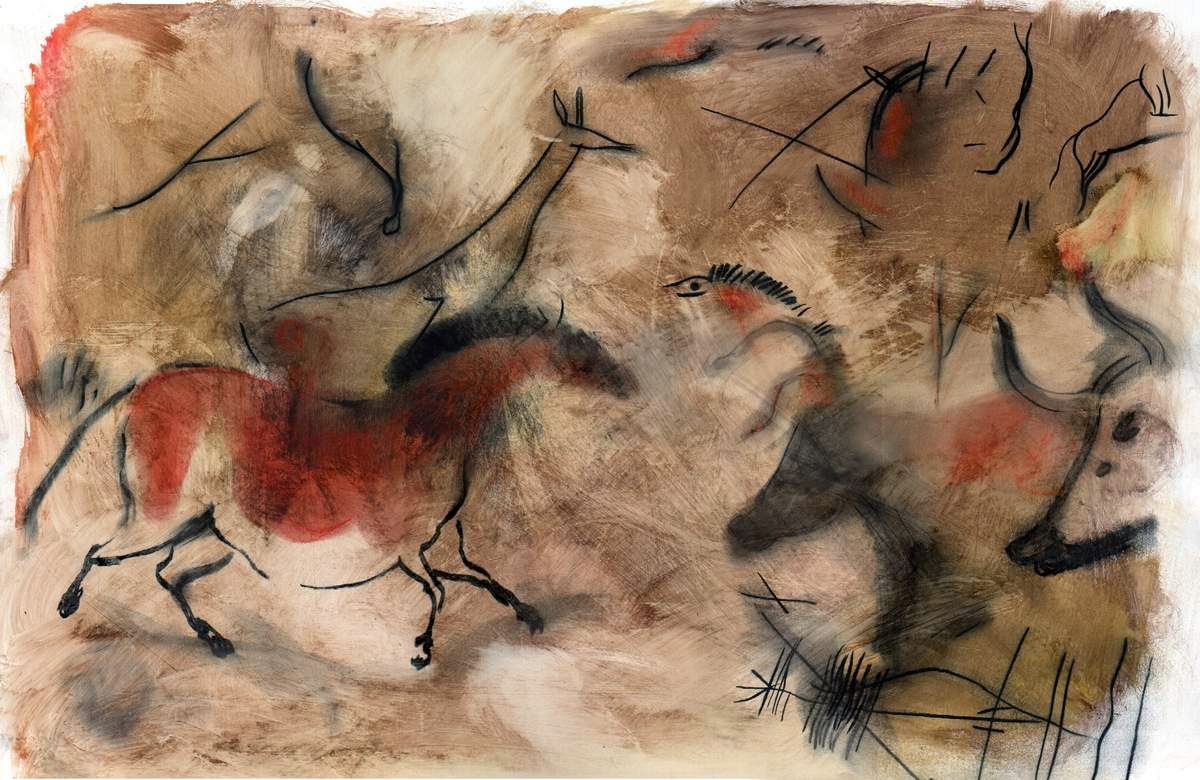
Animal have had a place in art for as long as there has been art. From the paleolithic artwork of the Caves of Lascaux to contemporary depictions, animals have long been part of human culture, myth, and symbol.

Sojourn Pamela Murphy
What do animals mean to our psyche? Many earth based cultures consider animals as spiritual counterparts, as messengers, and as partners in life on earth. Jung stated that animals were a relevant symbol of our psyche and often  represented the self.


Tiger Tiger Travis Louie

Theriomorphism: the ascription of animal characteristics to humans.

Stilts (Adaptation) Martin Wittfooth
There seems to be a resurgence of animal imagery in contemporary art. One theory for this is that we are compensating through art for a loss. As humans grow more urban our involvement with non human animals becomes increasingly rare. With the exception of those animals doomed to be commodities; as food, as pets, and used for entertainment - which could include animal sanctuaries and parks, as well as zoos - natural encounters with animals, wild or tame, are few and far between. The occasional encounter with deer becomes an almost magical moment, and happening across a coyote, bobcat, or bear, or even a wild turkey or goose, often causes fear or confusion. 

Mixed Metaphor II Robert McCauley
Anthropomorphism: the attribution of human characteristics or behavior to a god, animal, or object.

Intermission Theresa Elliott

The questionable practice, in my opinion, of using live animals as art has unfortunately also surged. As I write this, an Ibizan Hound is part of an exhibition at LACMA. This practice to me is an extension of perceiving animals as commodities. None of those images appear here, or of taxidermy based art, as these are simply, to my mind, further forms of animal exploitation. The very same mind set that allows people to feel comfortable with exploiting animals, may also allow them to feel comfortable exploiting people.

Enassamiian Tom Uttech


"There are some who can live without wild things and there are some who cannot." 
 - Aldo Leopold "A Sand County Almanac"

Monday, December 01, 2014

"Little Gems"

Girl With a Red Hat Vermeer 1665-66
oil on panel 9.1 x 7.1 inches
I can’t tell you who coined the term “Little Gems” when referring to artwork. I first heard it from a professor during an outdoor watercolor class. “We call those little gems.” he tossed the words back, over his shoulder, while sauntering off down the trail. I was working on an 8 x 10 page torn from my Aquabee sketchbook.

After the Rain Private Collection Katherine Kean
watercolor on cotton rag paper 4 x 7 inches
The term goes back at least to the 19th century. James Jackson Jarves, a newspaper editor and art critic, describing Fra Bartoleomo’s works:

     "In his earlier works, which approach miniature painting in fineness and delicacy, as for instance those little gems, the “Birth” and “Circumcision” of Christ, in the Uffizi, the composition is noble and beautiful, and the finish Leonardesque. Yet they have the force of large paintings.”


 Circumcision and Nativity Fra Bartolomeo circa 1500
tempera on wood 7.7 x 3.5 inches

For artists, working on small surfaces are an opportunity to try out new ideas, colors and composition, the small size means less cost for materials and less time committed. Plus they travel well and are easy to pack and store.

Willows at Sunset Vincent van Gogh
oil on cardboard 12 1/2 x 131/2 inches

Red Poppy Georgia O'Keeffe
Although Georgia O'Keeffe became known for her large flower paintings, her earlier flower paintings were enchantingly small. She began enlarging them to attract the attention of busy New Yorkers, however small works have also been known to draw focus. Crowds lined up in New York to view Carel Fabritius's The Goldfinch.

The Goldfinch Carel Fabritius
oil on panel 13 x 9 inches
There are advantages to the collector of small works as well. The small scale is ideal for those with limited space. They are easy to install – they work well in groupings, or in those niches in home or office. Really, you can put little gems of art anywhere; on a table, a shelf, or a tiny spot on the wall or they can be displayed on a tabletop easel. They are easy to store, easy to pack, easy to ship. They are very affordable for collecting and gift giving, and there just seems to be something inherently fascinating about miniaturization.

Angeles Forest Circling Storm 
Private Collection 
Katherine Kean
oil on linen 
6 x 6 inches

View or shop from a selection of little gems here: Little Gems Collection .

Monday, September 01, 2014

Happy Labor Day!

The Harvesters Pieter Brueghel the Elder 1565
oil on wood 46 7/8 x 63 3/4 inches

Above, the first "modern landscape" - unidealized, based on personal observations of atmosphere and nature's transitions through the seasons.

Enjoy the day, whether you are swimming, playing, picnicking or carrying sheaves.

Monday, August 04, 2014

Cape Cod Travels


After a hot, humid, and hectic beginning of summer, it was nice to spend a week traveling to Cape Cod to visit family, check up on the marsh, chase a few clouds, and look at a few art galleries. I was surprised, and delighted, to find the weather there less humid than Southern California, and cool, and green. Very, very green.


One of the galleries that I visited was Tree's Place, and I was fortunate to see a two person show of Karen Hollingsworth's and James Neil Hollingsworth's paintings. It was a gorgeous exhibition. Their work hung well together, and interacted, with some elements shared and differences that added to the interest.


Back home everything is as busy as usual. I'm having some work done on my yard and one of the crew is rehoming a stray female husky. I ended up inviting her inside to stay on two separate days. I was pondering adopting her - she's sweet, smart, graceful, and beautiful. My cat Zabrina loves dogs and wanted to meet her, but that didn't go very well. It seems the husky viewed her mostly as prey. However, there are many other interested parties, so I doubt she'll have any trouble finding a great home.


And lastly, when is a hole in the roof a good thing? For me, it's when it's getting ready for a skylight to be installed. I've been making changes to my garage so that it can double as a studio space when I need it. It's getting there...


Thursday, March 27, 2014

Thoughts From TRAC 2014: Part 2 Unofficial Art

Rembrandt Painter in Studio
So where does today’s representational painter fit in to this post modern art world?

Nowhere, apparently. According to the values that define Postmodern art, we do not make art. Don’t despair, we can still make work, it's just called something else, and that something is kitsch. Before anyone becomes offended, makers of kitsch are in good company. Robert Storr, now the dean of Yale’s School of Art, once named Andrew Wyeth “our greatest living ‘kitsch-meister'."

Wyeth Spring
As Jan-Ove Tuv explained in his presentation titled "Kitsch as Superstructure for Representational Narrative Painting", the values of postmodernism are non - objective, ironic and unemotional, making use of distancing objectivity, and innovation.

Kitsch, as defined by Keynote speaker Odd Nerdrum - is not the kitsch that we shrink from, meaning art that is in poor taste because of excessive garishness or sentimentality, but art that employs mastery of technique, combined with narrative, romanticism, and emotionally charged imagery – all of which are taboo for the postmodern artist. As a philosophy, the Kitsch Movement as Superstructure is based upon personal experience and is humanist in nature.

Odd Nerdrum Self Portrait in a Tree Trunk
Another term that has been suggested by Alexey Steele is Novorealism:
“Novorealism addresses the capabilities of evolutionary developed human sensory systems as opposed to technologically based expressions. Novorealism has opposite priorities to those of 'official art'. Instead of chasing novelty it strives for authenticity, instead of glorifying ugliness it contemplates beauty, instead of prescribed irony it searches for sublime, instead of detached objectivity it engages the personal, instead of craving shock, it strives for greatness.”

What is needed now? What stops representational art from becoming kitsch – and now I am referring to the other kind – the one that IS the art world “no - no"? In a word, authenticity.

Although I don't remember who said it, this stayed with me, "One must paint each brushstroke as originating in the heart and moving straight through your arm and on to the canvas."

 "You should be able to go to art with the burden of your life." Roger Sruton

Friedrich Winter Landscape

Bolton Hall Museum Gift Shop

The Bolton Hall Museum Gift Shop   is a great place to do your holiday shopping! Carrying a wide range of unique items, all are created l...