Showing posts with label Books. Show all posts

Tuesday, August 06, 2013

Reading The Art Forger

I found "The Art Forger" another fun and entertaining read, and almost as obsessed with surfaces, brush strokes, layers of luminous color, and compositional strategies as many how-to books on painting. The plot weaves art history with the contemporary, and references the mystery surrounding the Gardner Museum heist, in which two men disguised as ­police officers conned their way into the Isabella Stewart Gardner Museum, tied the guards up with duct tape, and made off with 13 artworks, including three Rembrandts, a Vermeer, and a Manet, altogether valued at $500 million. 

Pondering reproductions, copying, and forgeries tends to make one ponder basic questions about the value of art, doesn't it? If experts can not tell an authentic painting from a forgery, then what exactly are art buyers paying for? Is it status? Authenticity? Is it a look or a signature or a name? Or is it the participation in a unique and original vision that ownership provides?

Written in a first person narrative, the protagonist delves into details about forgery techniques, as she employs the famous art forger Han van Meegeren’s methods of painting. Van Meegeren used synthetic phenol formaldehyde resin dissolved in a spirit such as turpentine and/or an essential oil which would then be mixed with hand-ground powder pigments. This was then baked to change its chemical composition permanently, becoming insoluble in alcohol, or other common solvents. The results are described as so beautiful that I'm almost tempted to try it.

Monday, July 29, 2013

Resting, Recovering, Reading About Art

 While recovering I’ve had plenty of time to read, starting with Richard Schmid’s “Alla Prima” and Steve Martin’s “An Object of Beauty: A Novel.” I figure if I can’t make art then I might as well read about it, right?

Reading Schmid’s how-tos about direct painting when you can’t paint, but really, really want to is some experience. Normally I wouldn't have the patience, I'd much rather do it, even if it's wrong. Schmid reduces painting to the essentials, the simple steps that may not necessarily be easy to accomplish. He does a great job of breaking down a lot of valuable information into bite size pieces; selecting subject matter, palette choices and management, execution and finishing, and then smoothes it all out with some memorable tips. Squint at your subject matter (not at your painting), what to learn from your failures (figure out what is wrong and don't do it again), how to keep it simple (beware the lure of ostentatious techniques) and how to manage color to create harmonies (light does not lighten or darken without changing color). If you don’t already have this book, and are considering buying, know that there is an Alla Prima II coming out this fall – an expanded version.

Steve Martin’s novel takes the point of view of a collector. In that framework, it’s interesting to read some of his thoughts on what sparks an interest in a work, or erodes it. Along with the story, the dialogue is witty and relatable. “There is art in Los Angeles that rivals New York’s, but to see all of it you would need General Eisenhower to plan the attack. The Los Angeles County Museum of Art is miles from the Getty, which is miles from the Hammer, which is miles from the Norton Simon, which is miles from the Museum of Contemporary Art, and if the dots were connected on a map, you would see a giant circle running around the periphery of Los Angeles with no convenient route connecting them." And, trying to pinpoint the current non-art movement state of contemporary art: “There are a hundred categories. There’s ‘pale art,’ faint things with not much going on in them. There’s ‘high-craft OCD,’ you know, those guys who take a thousand pinheads and paint a picture of their grandmother on every one. There’s ‘low-craft ironic,’ a fancy name for wink-wink nudge-nudge.” Plus, there are reproductions worked into the narrative adding to the vicarious thrill of the "winding path that leads a collector to his prey."

One good read leads to another and I'm moving on to The Art Forger, Modern Art, An Almost Perfect Copy, and Eric Fischl’s Bad Boy.

Monday, July 23, 2012

Can artwork make you cry?

Has a work of art ever moved you to tears? That's a question that I asked last week while quoting James Elkins, author of Pictures and Tears: A History of People Who Have Cried in Front of Paintings. Some interesting responses motivated me to post this poll about artwork and emotions. Besides tears, does artwork ever make you laugh, feel excited, angry, frightened, confused, dizzy...? Share your experiences in the poll below or in the comments.

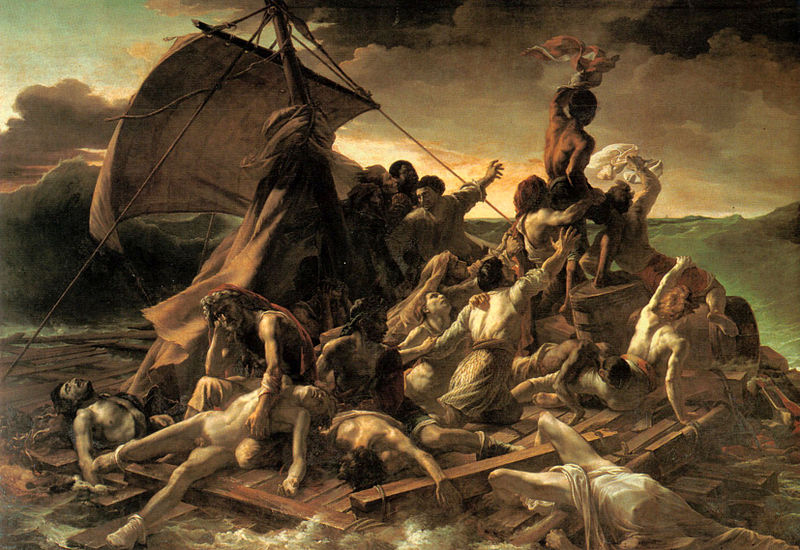
When I saw the painting below at the Louvre I felt dizzy and seasick. The large scale - about 16 by 24' and the strong diagonal lines tipping toward the viewer added to the sensation, as did the color.

 The Raft of the Medusa Jean Louis Theodore Géricault
Join the discussion in the comments here or on my Facebook page and post there any artwork that has given you a strong emotional response.

What emotions have you experienced while viewing art?

Monday, July 16, 2012

What Are You Reading This Summer?

My summer reading list includes wit, humor, and drama and some conversational topics to last well into the rest of the year.


  Michael Findlay entertains while looking at the value of art through three defining categories; investment value, social leverage, and aesthetic pleasure. Well illustrated with art and ancedote, he explains how all three contribute to how art is marketed, bought and sold, displayed, and lived with.


 In a series of essays written with eloquence, insight, and humor, Peter Clothier shows us the process of gently dismantling our outer edifice to allow in fresh awareness and genuine inspiration.


 This is for anyone who has an interest in environmental, animal rights, and wilderness issues - assuming that your definition of the wilderness includes the animals that inhabit and to some extent sustain it. Aren't all three interconnected? This book also appeals as a well written drama that brings to light problems with how terrorism has been currently defined and the impact that has on all of us and the resulting limits to our freedom and expression.

Let me know what you're reading.

Monday, July 09, 2012

Creation is Subtraction

Katherine Kean, original oil painting, dark blue, black, clouds, atmospheric, contemporary, luminous
Winds Around You ©2012 Katherine Kean
oil on linen 30 x 30 inches


“Creation is not capricious or random addition; it is intelligent and selective subtraction.” The God Theory: Universes, Zero-Point Fields, and What's Behind It All, Bernard Haisch

 I’ve always thought of the act of creating something as making something from nothing. As in, there’s a blank canvas in front of you and you fill it up with paint to make a painting. While reading Bernard Haisch's, The God Theory, which examines the intersection of science and spirituality,  I’ve learned a new way to look at creating that makes a lot of sense.

Creating is about filtering and selecting from everything. Our brains constantly filter information, and it’s a good thing, because otherwise there would be so many sensations and associations that it would be overwhelming to experience. So, through life we learn to sort out and filter out whatever we perceive as not important.

 The act of creating takes the filtered bits and brings parts of them together, allowing for new associations and fresh perceptions, although nothing new is really made. It just seems that way because the new format lets us experience it as if we’ve never seen it before.

  “The esoteric traditions tell us that creation by subtraction is one of the fundamental truths underlying reality. Put in terms that relate to the God Theory, these traditions teach that creation of the real (the manifest) involves subtraction from infinite potential.”

 So it's a about choices and preferences and making selections. An analogy of the process that Haisch uses in his book is of a projector and film; the light of the projection bulb is the source of all that is and the film is the filter that subtracts from the light:

  “The white light is thus the source of infinite possibility, and you create the desired image by intelligent subtraction, causing the real to emerge from the possible. By limiting the infinitely possible, you create the finitely real.” 

Pretty cool to think about, isn't it?

   "You cannot experience yourself as what you are until you encounter what you are not.”


Friday, June 17, 2011

What Do you Listen to While You're Working?

What do you listen to while you're making artwork? Is it music, the TV, the radio, your pet snoring, or maybe silence? I've learned that for me it's often helpful to have something in the background to keep my left brain occupied.

I have a television in my studio. It's placed slightly behind me, not to watch, but to hear. Too often it's tuned to news channels. I find the news compelling during natural disasters, but close to unwatchable during election years. Too often it's too depressing to leave on for very long.

I've recently rediscovered audible books. I've had books on tape in the past and now get books from Audible.com to listen to on a Kindle. I'm currently listening to The Time Traveler's Wife. Even though I've seen the movie version it's fun to hear it read aloud by Fred Berman and Phoebe Strole. Having two voices reading from the two perspectives of the story keeps it fresh and makes it more entertaining. I find it interesting also to notice the words that are chosen; how the words that are describing scenes that I can see in my head as a result of the movie differs from the words that
I'd use - and how the images in my head change as a result of these other words, even though it is the same story. This process reminds me of how large a part choices play in all art forms and how often what is left out may be as important as what is included.


Wednesday, September 08, 2010

Practical Advice for the Driven


I recently received a copy of Accelerating on the Curves: The Artist’s Roadmap to Success. This newly published book from Katharine T. Carter and Associates is a guide to career development for fine artists. I find it helpful that it divides a career into three segments: local, regional, and national, with clearly delineated directions and matkers for knowing where one is and what to strive for next in the general scheme of things. How clear is it? In addition to directions, included are sample cover letters to galleries, just in case you've ever wondered what to say or how to introduce yourself, samples of Press Kits, samples of resumes laying out the correct chronological order, and so on. There are essays from seventeen art world professionals and a section devoted to resources for artists.

With 363 pages I've just begun to get into this book - jumping into the sections I need right away. Not cheap, but full of value, I believe that it is only available through this link at the current time.

Tuesday, January 12, 2010

Saturday's Crowded Reception


Clouds Swirling Over the Great Marsh 18 x 24" oil on linen
© 2009 Katherine Kean

The painting above is included in The Best of TAG 2010 group exhibition. The opening reception was this past Saturday evening. It was wonderful to see a full crowd with both new and familiar faces. There were at least seven other openings happening at the same time so the parking lot was overflowing with the line of cars waiting to get in extending down the street all the way to the exit ramp and on the freeway. Many people said that they parked wherever they could and walked the rest of the way. Thanks to everyone who fought their way through the crowds to get there and my apologies to those that never did find a place to park and had to turn back. There is still plenty of time to see this exhibit. It'll be up through the 30th of this month.


We sold many signed copies of the book 100 Artists of the West Coast II, which includes the work of four TAG Gallery artists, myself among them. I think there are still a half a dozen of the signed copies left. Gallery hours are Tuesday through Saturday from 11am - 5pm.


Related Posts:


TAG Gallery Moves to Bergamot Station/Daily DuJour

TAG You're It/Art, Tiles, and Mosaics

Wednesday, December 30, 2009

Group Exhibition: Best of TAG 2010


I have one new painting included in this group exhibition at TAG Gallery's new location at the Bergamot Station Art Center in Building D-3. The exhibit runs from January 5th through the 30th. The opening reception of Best of TAG 2010 and book signing of 100 Artists of the West Coast II is Saturday, January 9th from 5 - 8pm. So bring your books if you'd like to have them signed, or just bring yourself and enjoy the artwork. I hope to see you there!

Best of TAG 2010
TAG Gallery
Bergamot Station Art Center, D-3
2525 Michigan Avenue
Santa Monica, CA 90404
310-829-9556
Hours: Tuesday through Saturday 11am - 5pm

Thursday, December 10, 2009

100 Artists of the West Coast II


I'm pleased to announce that a book that includes my artwork has recently been published. From San Diego to Vancouver, 100 Artists of the West Coast II covers 100 artists with over 400 full color photographs of their work. The collection includes art from private as well as public collections and installations, including the collections of the Los Angeles County Museum of Art, the San Francisco Museum of Modern Art, the Art Institute of Chicago, the Museum of Modern Art New York, and the New York Public Library to name just a few. I'm happy to be included.

Thursday, November 19, 2009

Something in the Wind

Leaves on the Wind
12 x 12" oil
© 2006 Katherine Kean

I’ve been reading about the wind. It’s high time, really. I live in a windy place - I guess everyone living near canyons and mountains does. It tends to be windy many mornings even when the rest of the city is experiencing calm. Then when it is windy for everyone we get extra.

When I first moved here with my then husband we were woken early one morning by half a house length of gutter that had worked loose from it’s mounting banging violently against the side of the house with each strong gust. It was beating the house so relentlessly that we were afraid that it would soon come crashing through the window. My ex husband bravely ran outside and wrestled the gutter to the ground. As the wind was showing no sign of abating and lacking a method to secure it he held it there in check while I searched for something to sever it with. A kitchen knife finally did the trick. Another time I was working in the studio on a windy day when I heard a loud BANG. I ran upstairs from the studio to see what was going on. On the deck I found that the wind had plucked the patio umbrella out of it’s holder and driven it straight into the side of the house where it remained stuck like an oversized, festive dart.

The book I’m reading, Jan DeBlieu’s
Wind: How the Flow of Air Has Shaped Life, Myth, and the Land explains the many facets of wind from a cultural and journalistic perspective. I'm reading about the speed of wind, where and how it forms, how it has affected historical events. I'm especially enjoying learning the many ways the wind is known from exotic names (scirocco, foehn), to weather terms and sayings (a backing wind), to poetry ("the wind's feet shine along the sea," Swinburne).

Thursday, October 29, 2009

Reading About the San Gabriels - Tall, Steep, and Now Waterproof

Clouds Over Great Marsh Sketch
© 2009 Katherine Kean


While I'm seeing the light at the end of the tunnel with the large paintings, I'm also looking forward to getting on with some new work, such as a painting from the sketch above. I've finally seen a clear change of season with the chilly Santa Ana winds - the first ones in many years bringing no accompanying anxiety. I was amazed yesterday by fantastic dust and ash cloud that the winds kicked up. The descent into winter here includes some cold days punctuated by a day or two in the 80's, accompanied by thoughts about the impending rainy season. I've been reading John McPhee's The Control of Nature, specifically the chapter "Los Angeles Against the Mountains". McPhee's reporting style is entertaining as he lays out the hazards of living next to the "unimproved wilderness" known as the San Gabriel Mountains, among them:

1. Steep and rugged, the San Gabriels are twice as high as Mt. Washington - from base to summit 3000 feet higher than the Rockies.

2. Some of the most concentrated rainfall in the history of the US has occurred in the San Gabriel Mountains.

3. Burned chaparral releases wax like resins that coat the soil particles, creating a waterproof layer one to six centimeters down.

All of this together sets the scene for the "full scale flat-out debris flows", which McPhee reports on in his book.

There is another chapter in the book that I've yet to read, "Cooling the Lava" - I can hardly wait.

Bolton Hall Museum Gift Shop

The Bolton Hall Museum Gift Shop   is a great place to do your holiday shopping! Carrying a wide range of unique items, all are created l...